Mikrohes Completes Next-Generation Archimedes Screw Turbine Project
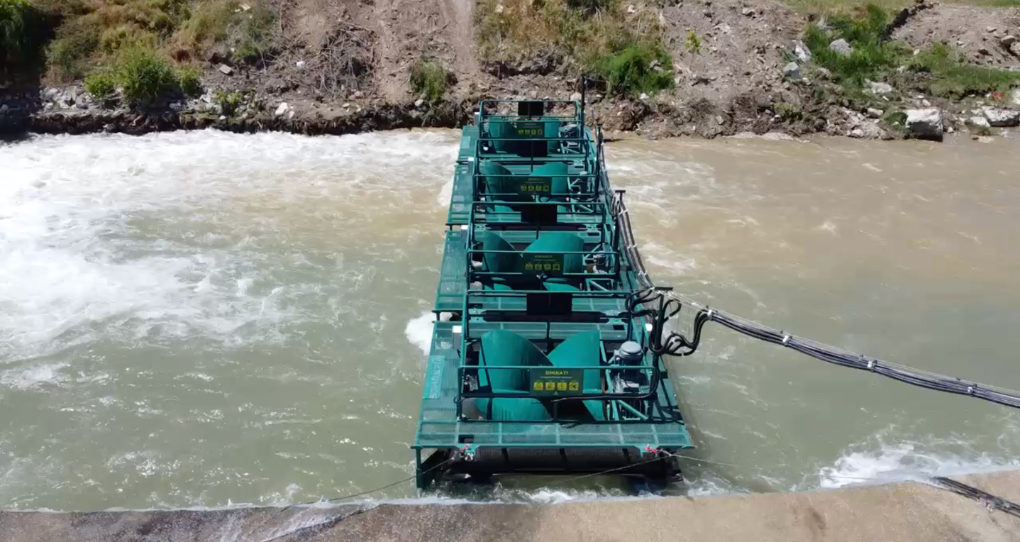
YEO Teknoloji said its subsidiary Mikrohes Teknoloji Enerji Sanayi, had completed a research and development project aimed at creating a next-generation Archimedes screw turbine.
The project, titled “Hybrid-Floating Horizontal Archimedes Screw Turbine Energy Field,” received support in 2023 under TÜBİTAK’s 1509 International Industrial R&D Projects Support Program and the Eureka Network.
Alongside Mikrohes Teknoloji, the project involved Reap Batarya, YEO Teknoloji and the British engineering company Dyrhoff. Enerjisa Üretim also contributed as an implementation partner.
According to the company, the project was designed to make more effective use of the energy potential of low-flow waterways. It combines hydrokinetic power generation, battery energy storage, intelligent power electronics, remote monitoring and energy management within a single modular structure.
The system allows the electricity generated to be consumed directly, supplied to the grid or stored in batteries, depending on demand. Its remote-monitoring infrastructure also makes it possible to track the facility’s generation performance, water-flow conditions, battery status and overall system efficiency in real time.
The modular design allows multiple turbines, rather than a single unit, to operate together at the same site, enabling the development of hydrokinetic energy fields that can be expanded to meet different capacity requirements.
Megawatt-Scale Hydrokinetic Energy Fields Are the Next Target
According to the company, the technology’s modular design, rapid installation process and limited need for large dams or extensive infrastructure could make it a viable source of power for rural communities, agricultural facilities and settlements with restricted access to the grid.
With that goal in mind, the company plans to develop clean, distributed and scalable energy projects in regions where gently sloping rivers are common, particularly in Africa. It ultimately aims to establish Megawatt-scale hydrokinetic energy fields in which numerous modular platforms operate together.
Türkiye Has Nearly 300 Megawatts of Potential
In 2021, YEO Teknoloji acquired a majority stake in Mikrohes, which was founded in 2013 and commissioned Türkiye’s first licensed and unlicensed power plants based on the Archimedes screw principle.
According to YEO Teknoloji’s latest activity report, environmental-flow projects alone could offer between 250 and 300 Megawatts of potential capacity for the technology in Türkiye. The report estimates a capacity factor of roughly 80 to 90 percent, corresponding to annual electricity generation of about three billion kilowatt-hours.
The report said that projects developed by Mikrohes could unlock significant energy potential in underused settings, including tailrace channels, environmental-flow outlets and agricultural irrigation canals.
It also noted that the technology could be used at industrial facilities and thermal power plants, where cooling water could be converted into electricity for on-site consumption, helping to reduce the facilities’ carbon footprints.
The First Archimedes Screw Turbine Began Generating Electricity in 1997
Invented by Archimedes in the third century B.C., the Archimedes screw was originally used to lift water from lower elevations for irrigation and drainage.
In 1991, Karl-August Radlik reversed the principle for use in electricity generation and patented the technique.
The first turbine based on the technology, with a capacity of four kilowatts, was installed in 1997 on the Eger River in Aufhausen, Germany. The first commercial turbine followed in 2000 on the Fränkische Saale River in Hammelburg, Germany.
Although no definitive global count is available, thousands of turbines using the technology are believed to be in operation worldwide.
For licensed hydroelectric projects, Mikrohes also converts developments that might otherwise carry high costs or pose risks to nearby communities and ecosystems into cascading systems. The company says this approach can make such plants more environmentally responsible, economical and efficient, while reducing their ecological impact and improving the sustainability and cost-effectiveness of electricity generation.