
VakıfBank to Finance Circular-Economy Investments
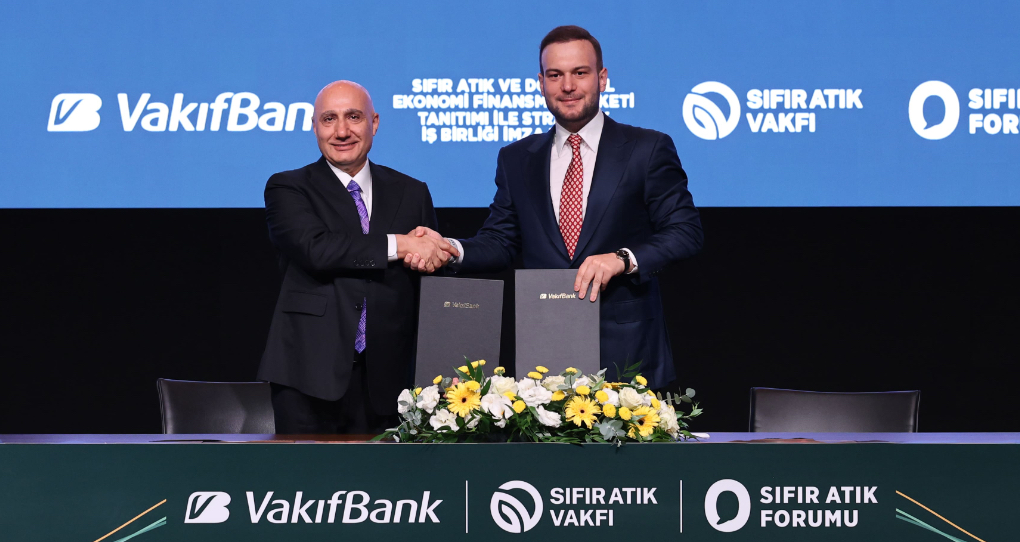
VakıfBank and the Zero Waste Foundation have launched a new financing program aimed at supporting investments in the circular economy, the two organizations announced.
The partnership agreement was signed by Osman Arslan, the chief executive of VakıfBank, and Samed Ağırbaş, president of the Zero Waste Foundation.
The Circular Value Financing Package is intended to help companies and public institutions make the transition to a circular economy. Businesses seeking to transform their production methods and operations will be offered a range of financing options for both investment and working-capital needs.
Under the program, investment loans of up to 50 million lira will be available with maturities of as long as 60 months, while large-scale project financing may extend to 120 months. Businesses will also be eligible for up to 10 million lira in working-capital financing, with maturities of as long as 24 months.
To make financing more accessible for small and midsize businesses investing in circular-economy projects, the Credit Guarantee Fund will also provide 3 billion lira in guarantee support.
The program will be open to businesses in a range of sectors, including manufacturing, plastics, packaging, textiles, automotive suppliers, machinery, electronics, retail, waste management and recycling, as well as companies owned or affiliated with municipalities.
In its first phase, the initiative aims to reach more than 500 organizations and projects and provide a total of 10 billion lira in financing.
Eligible investments will be expected to reduce the use of virgin raw materials, increase the use of recycled and secondary inputs, and improve energy and resource efficiency.
Financing will also be available for circular business models based on sharing, leasing and reuse, as well as investments in the transportation of waste and recoverable materials, resource recovery and remanufacturing.
The program will offer working-capital financing to qualifying businesses engaged in circular production, while larger circular-economy investments may receive project financing.
Under the partnership, the Zero Waste Foundation will assess whether financed projects meet circular-economy criteria and will monitor indicators measuring their progress. VakıfBank, meanwhile, will oversee the lending process in accordance with its credit policies, risk-assessment standards and internal authorization procedures.
Osman Arslan, VakıfBank’s chief executive, said the initiative was intended as more than a one-time financial product.
This package is not a one-off financing product for us,” he said. “It is one of the first steps in developing new solutions in the areas of the circular economy, green transition and resource efficiency. In the period ahead, we will also combine our international funding sources and sustainable-finance capacity with new products designed to accelerate this transformation.”
Arslan said VakıfBank had raised a total of $7.1 billion in new funding from international markets during the first half of 2026, with 38 percent of that amount classified as sustainable finance.
Ağırbaş said that although there was strong appetite in Türkiye for investment and transformation in the circular economy, several obstacles continued to prevent that potential from translating into actual investment.
Among them, he said, were high upfront investment costs, long payback periods, collateral and co-financing requirements, and limited capacity to prepare viable projects. He emphasized the need for accessible, long-term financing tailored to the particular requirements of circular-economy investments.