
Hyundai Begins Electric Vehicle Production in Türkiye
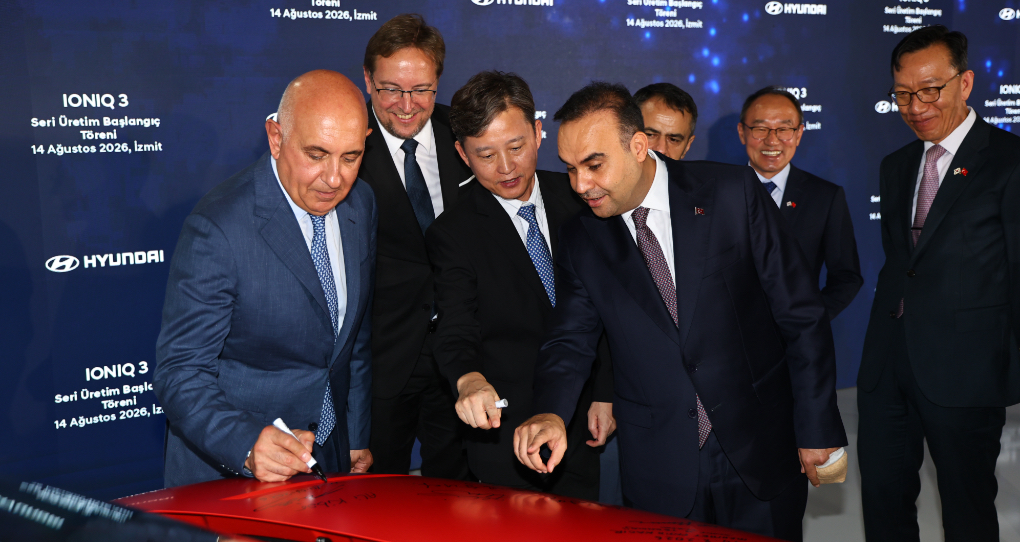
South Korean automaker Hyundai has begun mass production of its fully electric IONIQ 3 model in Türkiye, following a ceremony at its plant in İzmit.
With the investment, Hyundai became the second automaker after Türkiye’s domestic automaker Togg to manufacture fully electric vehicles in Türkiye.
Hyundai plans to produce 30,000 vehicles a year in the initial phase on the new production line, which was brought into operation with a total investment of €250 million, including €55 million for a battery production line.
Speaking at the ceremony, Industry and Technology Minister Fatih Kacır said the investment demonstrated that Türkiye’s vision for next-generation mobility was gaining traction among global automakers and underscored the country’s position as a reliable and scalable manufacturing hub.
Xavier Martinet, chief executive of Hyundai Motor Europe, said Türkiye had a strong automotive tradition, a skilled work force, a competitive supplier base and a strategic location between Europe and Asia.
Martinet said the investment decision reflected Hyundai’s confidence in Türkiye and in the country’s potential to play a role in Europe’s transition to new forms of mobility.
Alex Kim, chief executive of Hyundai Motor Türkiye, said about half of the factory had been modernized as part of the investment. He added that the company planned further investments in a range of areas in the coming years to increase production capacity.
The plant, established in 1997 as Hyundai’s first manufacturing facility outside South Korea, now has an annual production capacity of 230,000 vehicles following the latest investment.
Since 1997, the factory has produced 3.4 million vehicles across 13 models, of which 2.6 million have been exported, primarily to European markets.
Hyundai has invested a total of €1.47 billion in the plant to date and plans an additional €715 million in investment.
Together with its Kia brand, Hyundai sold 370,000 electric vehicles globally in the first half of 2026, giving it an 8 percent share of the global electric vehicle market during the period.